
Chimney Sweep: Repair or Replace? How Highlands Ranch Homeowners Decide
Most Highlands Ranch homeowners call us thinking they need a new chimney. Almost none of them do. When we inspect a chimney here, the problem is usually the liner or the crown, two components that fail first and cost the most, and two components many homeowners didn’t know they had until a quote showed up. Deciding between repair and replacement starts with understanding what actually failed and why. If you’d rather have someone look at it than guess, call (833) 482-6314.
Your Chimney Is a System, Not a Single Structure
The phrase “replace the chimney” is misleading. A chimney is a stack of distinct parts, and each one ages on its own schedule. When a quote says replace, it almost always means one or two of these, not the whole assembly.
- Firebox: the chamber where the fire burns. Masonry fireboxes crack and spall; prefab fireboxes can be relined.
- Flue liner: the clay tiles or metal pipe that carries smoke and gases up and out. This is the component that fails most often and costs the most to fix.
- Crown: the concrete cap at the very top that sheds water away from the masonry. A cracked crown is the single most common source of chimney water damage in Highlands Ranch, where freeze-thaw cycles work on it every winter.
- Flashing: the metal seal where the chimney meets the roof. Failed flashing lets water in at the roofline, not the top.
- Chimney cap: the hood over the flue opening that keeps rain, snow, birds and downdrafts out.
- Chase or chase cover: the framed enclosure around a prefab flue, common on newer homes in Highlands Ranch.
Most repair quotes target liner. When it’s the crown or flashing, we tell you. When it’s the liner, we explain what kind of failure it is, because that decides the repair path.
The Liner Decision: Resurfacing or Full Reline?
For a deteriorated clay tile liner, the right repair depends on what shape the flue is in, not on what’s easiest to sell. There are two legitimate paths, and each fits a specific failure mode.
When HeatShield resurfacing is appropriate
HeatShield is a flue restoration system that resurfaced the inside of a clay flue with a ceramic-based compound, sealing cracks and restoring a smooth, continuous flue surface. It’s the right call when:
- The clay tiles are intact in structure but have surface cracking, spalling or gaps at the joints
- The flue has a consistent shape and isn’t severely offset or out of round
- The original liner is still largely in place and just needs a protective layer
- You want to preserve the existing flue and avoid the price of a full metal insert
Resurfacing with HeatShield is often a fraction of the cost of a full stainless reline and, for the right failure mode, can be the more durable long-term fix because it seals the whole interior rather than just lining it.
When a full stainless steel liner insert is the right call
An insert liner is a new flue inside the old one. It’s the correct answer when the old clay is structurally gone or the flue can’t be resurfaced at all:
- Tiles are cracked through, missing chunks, or the flue is collapsed
- The flue is heavily offset, out of round, or too irregular for a resurfacing compound
- The original liner has separated from the chimney walls
- The appliance being vented requires a specific flue size or material rating the existing flue can’t meet
A stainless insert is a bigger ticket than resurfacing. If a company quotes you a full reline without explaining which type of failure they found, ask them to show you. You’re entitled to see the photo or video footage. We use DuraFlex for insert liners because it’s a professional-grade product, and we’d rather explain why than just hand you a number.
Prefab Fireplaces Have a Shelf Life
Most prefabricated fireplaces have a rated service life of 20 to 30 years. Highlands Ranch had a lot of home construction in the 1990s and into the 2000s. That means a large share of prefab fireplaces in the neighborhood are now in their last decade and some are past it. For these, the repair-versus-replace question changes: a chimney at end of life is a replace decision regardless of how good the repair is.
What that looks like in practice:
- Prefab with original chase cover and cap: if the chase cover is rusting through, a good replacement cover with correct flashing and a new cap protects it, sometimes adding years.
- Prefab with a failing firebox: the firebox walls on a prefab unit aren’t repaired to the same standard as masonry; often the unit itself is replaced.
- Prefab with a rusted flue and degraded chase: this is generally a system replacement, not a patch.
For prefab systems, the components are often proprietary to the original maker. We stock and work with Famco and Copperfield product lines for cap and chase cover material, because getting the right size and fit matters more with a prefab than on masonry. If a contractor offers a “universal” cover on a prefab chase, that’s a short-term fix at best.
One other note on prefab: on a prefab system, the chase cover and the chimney cap are two different components. A cracked or rusted chase cover is a water problem; a missing cap is a smoke and draft problem. Fixing one doesn’t fix the other.
What a Repair-or-Replace Decision Should Cost
Homeowners ask what repair versus replacement looks like on the invoice before they’ve even had the inspection. Here’s a starting framework for a typical Highlands Ranch chimney. These are estimated ranges; the written estimate you receive after inspection is the final word.
| Work | Typical Estimated Range |
|---|---|
| Flue resurfacing (HeatShield) | Middle of the range, usually a few thousand dollars |
| Full stainless insert reline | Higher than resurfacing, materially larger job |
| Cap and crown repair | Lowest of the common chimney repairs |
| Flashing replacement | Usually modest, but critical for water control |
| Full firebox rebuild (masonry) | Large repair, sometimes comparable to partial rebuild |
| Full masonry chimney rebuild | The largest category, many thousands |
That last one is why we spend time on the decision. A full masonry rebuild is a major project. Most chimneys don’t need it. They need the liner addressed, or the crown and flashing, or a cap. When you break the quote down by line item, the repair/replace decision becomes a comparison between two or three specific numbers, not a single “do it all” verdict.
Ask any company for the quote broken down the way a written inspection report reads: liner, crown, flashing, cap, firebox, each with a notation of what’s repairable and what’s at end of life. If they quote it as a single lump sum, don’t sign until you understand what’s included.
What a Level 2 Inspection Report Should Show You
You can’t make an informed repair-or-replace decision on a verbal recommendation. A proper Level 2 inspection should produce a written report with photo or video evidence of each component it describes. Ask for these items:
- Photos or video of the flue interior, from the top and from the firebox up
- A written description of the liner’s condition and where it fails
- Notes on the crown, flashing, cap and chase, with photos
- The firebox condition, including masonry or prefab type
- A clear recommendation with a line-item estimate for each repair
- A note on which items can safely wait
We say inspect before we recommend because a verbal “you need a new liner” is not a diagnosis. If you get one, ask for the documentation. If the company can’t provide it, that’s a reason to get a second look. This is a chimney repair area where an accurate inspection is what separates a necessary fix from an unnecessary bill.
When to Call a Pro
You can do a little observation yourself without climbing on the roof: look for water stains on the ceiling near the chimney, chunks of chimney material on the roof or ground, a crown that looks cracked from the yard, or a smell of smoke in the house when the fire isn’t going. Call a pro when you see any of that, or when you can’t remember the last time the chimney was inspected.
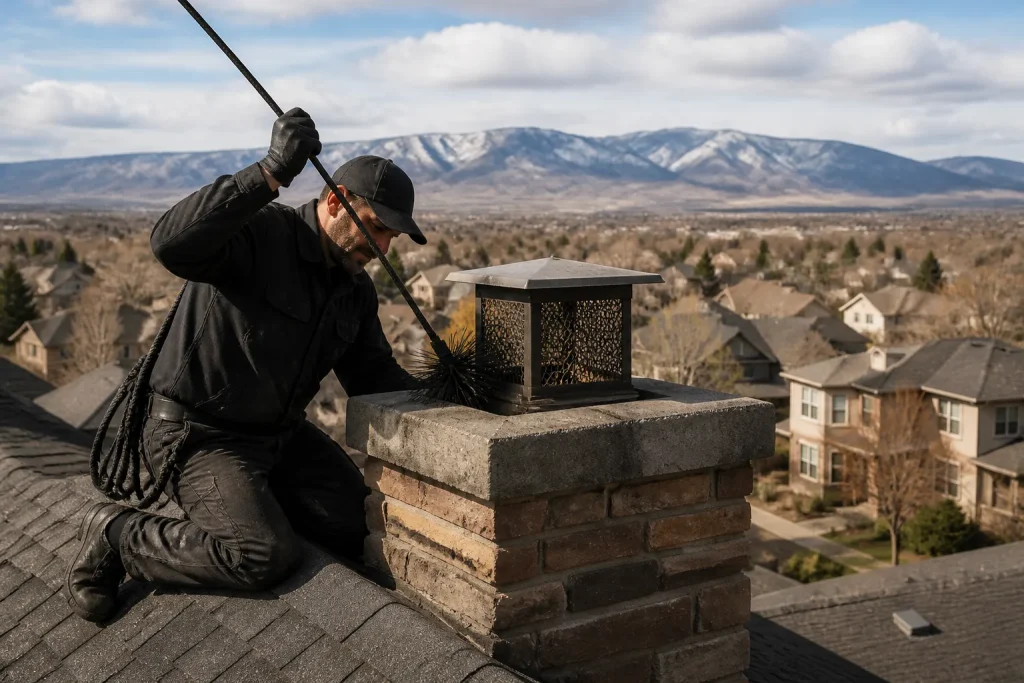
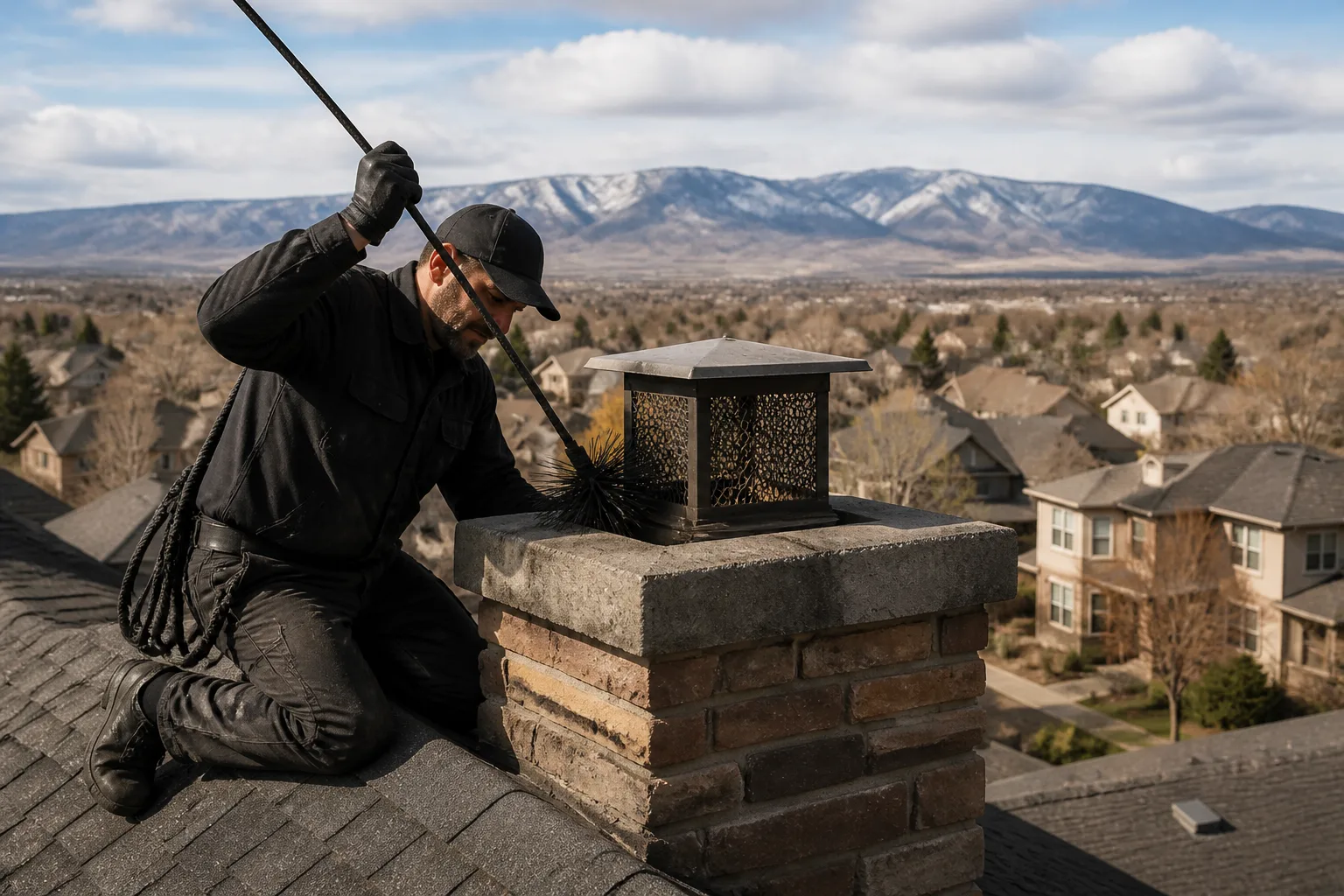
What you shouldn’t do is open up a flue or the firebox yourself to diagnose it. The inside of a chimney is not a place to explore, and a chimney fire or carbon monoxide issue is not something to guess at. A trained technician sees it with a camera and knows what’s normal and what’s not. We also recommend an annual chimney sweep as the baseline; a sweep is where most problems get noticed early.
If the repair turns out to be at the firebox rather than the flue, that’s fireplace repair and a different set of parts. One specialist handles both, so you’re not coordinating a sweep company and a mason and a cap installer on the same chimney.
Related services in Highlands Ranch: chimney sweep, chimney inspection, chimney repair, fireplace repair, and cap and crown installation.
The Bottom Line
A chimney replacement in Highlands Ranch is rarely the whole chimney; it’s usually the liner, the crown, or a prefab unit that’s reached the end of its rated life. Ask for a Level 2 report with photos and video, ask for line-item estimates, and ask what can safely wait. Then decide. If you’re in Highlands Ranch and need help, Highlands Ranch Chimney Sweep offers free estimates. Our technicians have up to 8 years of experience, and we use professional-grade products like HeatShield and DuraFlex for the repairs that need them. Call (833) 482-6314. We answer 24/7. Fast dispatch from 7am to 7pm, Sunday through Friday.
Frequently Asked Questions
Once a year is the general rule for a wood-burning fireplace, and it’s what we recommend for most homes. A gas fireplace still benefits from an annual inspection even though it produces less creosote. Highland Ranch freezes and thaws repeatedly through the winter, and that cycle works on the crown and flashing every year. Call (833) 482-6314 to book a sweep.
Not always. Many liners that look bad from a quote can be resurfaced with HeatShield if the clay tiles are structurally intact but cracked or spalling at the surface. A full stainless insert is the right call when the clay is missing, collapsed, or too irregular to resurface. The difference is visible in the inspection photos. Ask to see them. Call (833) 482-6314 for a free estimate.
It depends on the failure. A cracked crown or failed flashing lets water into the masonry, which worsens every freeze-thaw cycle and eventually damages the structure. A compromised liner lets heat and gases reach combustible material. Neither is an emergency on day one, but both get worse and more expensive if left. Our advice: get it inspected now, and we’ll tell you what can wait a season and what shouldn’t. Call (833) 482-6314.
Yes, in most cases. Chimney work is component work: liner, crown, flashing, cap and firebox each get repaired or replaced on their own. Full rebuilds are rare and should be reserved for chimneys where the masonry body itself is failing. If a quote tells you the whole chimney needs replacing, ask for a line-item report that shows which components failed. Call (833) 482-6314 for a free estimate.
Contact
If your Highlands Ranch chimney has a crack, a stain, or a quote you’re not sure about, we can take a look and give you a straight answer. Call (833) 482-6314 for a free estimate. We answer 24/7. Fast dispatch from 7am to 7pm, Sunday through Friday. Visit Highlands Ranch Chimney Sweep to learn more about how we work.
Written by the team at Highlands Ranch Chimney Sweep.
Need Chimney Cleaning Help?
Call Highlands Ranch Chimney Sweep - the local pro we connect you with is licensed and insured, here with fast help in Highlands Ranch.
(833) 482-6314